
Maryland’s forests and forest industry are key to the environmental sustainability of our natural systems and the health of the Chesapeake Bay. An ecosystem-based approach to managing and harvesting Maryland’s forests can enhance the state’s industry while providing solutions to mitigate climate change. The Hughes Center is proud to fund scientific research that has a positive impact on forest health in Maryland.
Current Forest Health Research Portfolio
Forest health impacts of coastal saltwater intrusion in Chesapeake Bay tributaries
PI: Dr. Keryn Gedan (George Washington University)
Co-PIs: Dr. Becky Epanchin-Niell (University of Maryland), Dr. Kate Tully (University of Maryland), Dr. Pinki Mondal (University of Delaware)
Funding: $141,437
Description: Saltwater is increasingly moving inland along Maryland’s Eastern Shore, killing trees and creating what are often called “ghost forests.” Over the past 40 years, about 24,000 hectares (nearly 60,000 acres) of coastal forest in the Chesapeake Bay region have been lost, much of it converted to tidal marsh. Aerial surveys show damaged forest expanding from roughly 7,000 hectares in 2012 to more than 17,000 hectares by 2023. Landowners and foresters are concerned, but it is still unclear exactly why some forests decline faster than others. This project will analyze forest conditions and environmental factors, such as saltwater intrusion, across Maryland’s Eastern Shore to better understand what is driving forest loss and to improve our ability to predict and manage future impacts.
Recently Completed Forestry Research
Woodland Stewardship
Most woodland parcels in Maryland are small, between 1 and 9 acres in size. But do these landowners know how to care for these woodlands, based on the landowner's goals for the property?
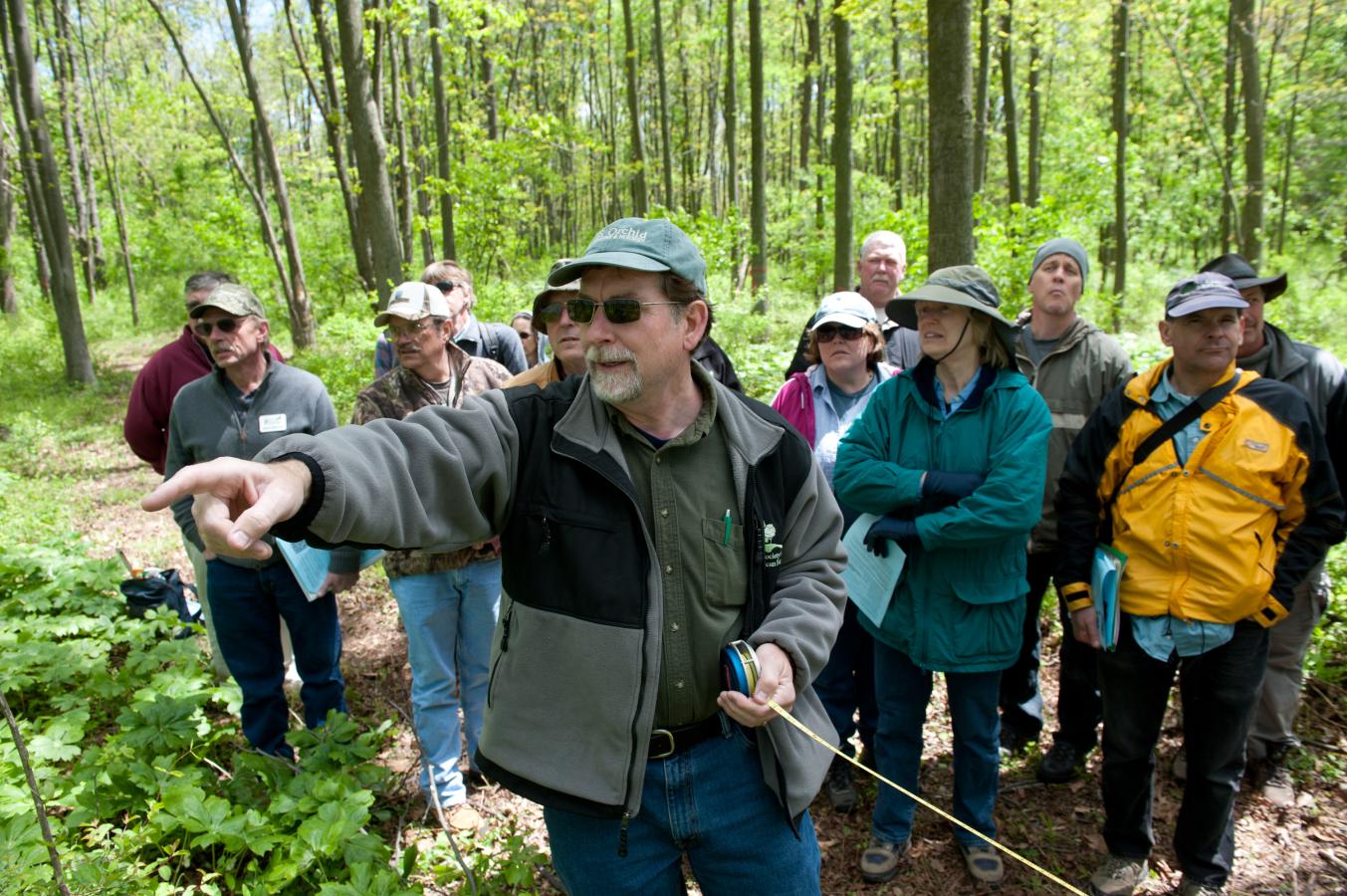
The Hughes Center extended funding to a project to increase woodland stewardship on Maryland’s small-acreage properties.
University of Maryland Extension (UME) Principal Agent Emeritus Jonathan Kays continues to work on this project, which saw some delays due to the COVID-19 pandemic in 2020. During the pandemic, UME developed a diverse, multi-state partnership with extension organizations from Virginia and Pennsylvania, state forestry organizations, and the Alliance for the Chesapeake Bay to create a new Woodland Health Practices Handbook. What started as a project focusing on one state has since become a working partnership called the Woods in Your Backyard Partnership, which has a host of other resources online.
During the last year, the hands-on content of the Handbook has been distilled into a quick-reference field guide on land care practices that can help green industry professionals and landowners implement practices to meet the goals for their woodland property. Most (85%) woodland parcels in Maryland are from 1 to 9 acres in size, a trend caused by continued parcelization of the landscape. Some landowners want to see their woodlands used for recreation purposes and others for wildlife, while others may not have any plan or know where to look for service providers.
The project objective is to develop quality resources and training for green industry professionals (landscapers, arborists, foresters, etc.) who want to expand their business model and learn how to implement Natural Area Management Services for small-acreage property owners. Landowners who wish to implement their own land care practices also benefit from all the resources.
Throughout the life of the Woods In Your Backyard Project, the principal investigators in concert with members of the Partnership have hosted numerous regional training webinars and in-person trainings on woodland practices using the developed print and digital resources, most available free of charge. The Woods in Your Backyard Partnership has tentative plans for a Natural Area Management Services webinar series in the fall of 2023.
Kays said in a recent update on the project that he is working with on efforts in Western and Central Maryland to implement sustainable timber harvests on university properties that can be used for extension programs to demonstrate forest management practices first-hand.
All three printed resources from the project are available for sale by title from Penn State University by searching Woods In Your Backyard: The most recent Woodland Health Practices Field Guide and is now available for sale for $7.50: extension.psu.edu/woodland-health-practices-field-guide.