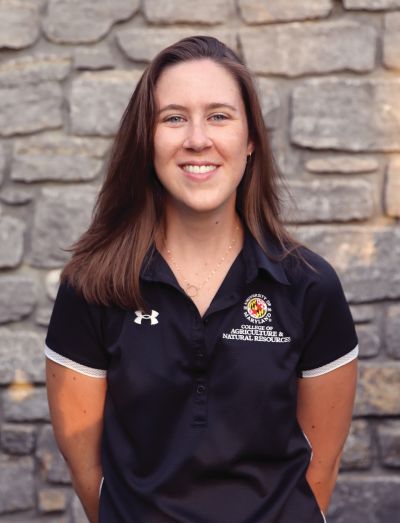
 Megan Calloway is AGNR’s campus farm manager. She supervises a wide-ranging set of initiatives, most importantly student learning and engagement on the farm, facilities management, and health and wellness for the farm’s many animals. We talked with Megan about what happens on the farm that its many visitors do not see, and strategies for keeping the farm relevant and up-to-date as AGNR seeks to meet the demands of a modern animal sciences education.
UMD's campus farm is a wonderful tourist attraction for campus visitors, but there's so much more happening than meets the eye. Tell us what goes on behind the scenes.
Behind the scenes, there are a ton of students working to help keep us running 365 days a year. We have a dedicated group of students consisting of a farm crew, volunteers, and interns that do most of the day-to-day tasks on the farm, including twice-daily feeding and (sometimes) twice-daily goat milking. Many of our students will join us as volunteers and progress to leadership roles as interns or farm crew. Depending on the season, students from management classes will help with animal care as part of their class duties. Throughout their time, students have opportunities to help with everything from vaccinations and hoof trimming to managing sheep breeding and ultrasounding our ewes for pregnancy. There is also a lot of animal movement behind the scenes. As we are a small farm, we only keep some animals for a short period to allow classes to use them. So we do a lot of trailering livestock to and from the farm to a variety of locations, including our research and education centers.
You have a rich background in animal sciences with a master’s focused on beef cattle reproduction, as an animal sciences instructor here at UMD, and now farm manager. How important is it to bring scientific and instructional knowledge to the table to keep the farm operating at a high level?
Scientific knowledge is, and should be, the backbone of everything we do. We are lucky to live in the digital age and to work with leaders in their respective fields to manage age-old issues as well as new issues as they arise. My background in beef cattle reproduction has helped me introduce estrous synchronization (bringing females into heat at a similar time) into our sheep flock and goat herd, and we hope to continue growing and add goat artificial insemination (our AI!) to the farm’s repertoire as well. Instructional knowledge of how courses run, especially our ANSC labs, really helps me balance the various needs of the department, our students, and our animals.
The farm has been a central point of interest on UMD’s campus for decades, but over time some of the facilities have eroded with a limited budget for upgrades. How have you and the department been able to adapt to make sure we are still offering a high-quality educational experience?
Last summer, we started strategically updating the inside of two of our barns to make better use of the space, improve our swine facilities, and allow us to add dairy goats to the farm. We also purchased equipment to fill out our sheep handling system so that we can meet industry standards and improve welfare related to handling our sheep. While these updates have been helpful, there are still many places around the farm that need modernization and improvement.
What does the future of animal sciences education look like and what role should the campus farm play in facilitating the best possible experience for our students, animals, and campus visitors?
The future of animal sciences education should still have hands-on experience at the forefront. To do that we should be upgrading all our facilities and equipment to incorporate modern animal agricultural practices related to welfare, nutrition, biosecurity, and data management. Two of our barns are retrofitted cattle barns which could be more extensively renovated to better suit our wide array of animals. Ideally, we would also build a new teaching and administration building to allow classes to be self-contained on the farm which would improve our biosecurity.
We are grateful to the AGNR donors who, over the years, have supported a range of upkeep projects at the campus farm. Thank you for helping us sustain this vital learning and research space.
If you’d like to support Campus Farm modernization efforts, please connect with AGNR’s chief development officer, Carolyn Fernandez: cfernanc@umd.edu
